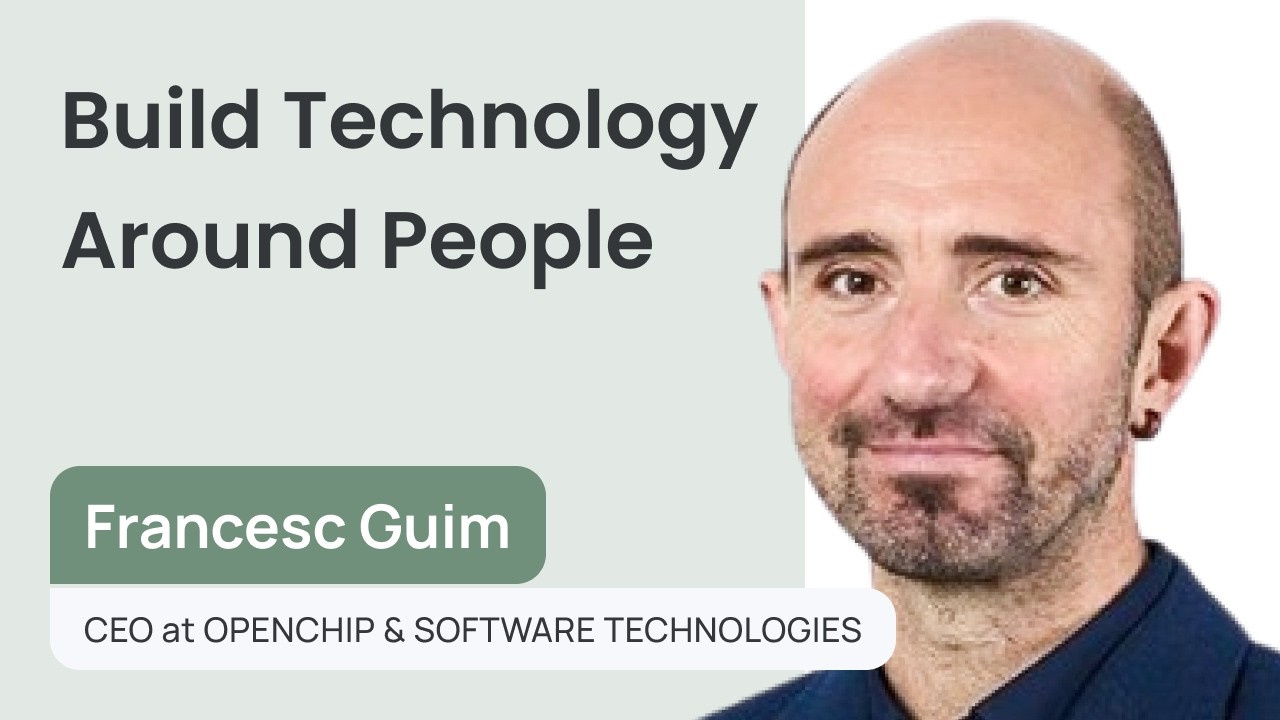
Francesc Guim, CEO of OPENCHIP & SOFTWARE TECHNOLOGIES, has spent his career turning ambitious technology ideas into systems with real-world impact. With a PhD in high-performance computing and distributed systems, he went on to spend nearly two decades at Intel, working across CPU design, system architecture, edge computing, and data center technologies. Along the way, he contributed to more than 500 patents, building a deep understanding of innovation while learning that technology only matters when it creates meaningful value for people.
That philosophy eventually brought him to OPENCHIP, a European technology company focused on developing sovereign computing capabilities and reducing Europe’s dependence on technologies built elsewhere. When Francesc joined the company around two and a half years ago, the organization was starting almost from scratch. Since then, it has grown to nearly 400 people across five countries and reached major technical milestones, including its first two-nanometer tape-out and European silicon already running operating systems and real applications.
Moving from a global corporation to a fast-growing technology venture gave Francesc the opportunity to rethink leadership around agility, transparency, bold decisions, and collaboration without unnecessary silos. In this conversation, he shares what it takes to build advanced technology from the ground up, why meaningful innovation sometimes requires taking risks, and how OPENCHIP hopes to contribute to a more independent and democratized future of computing.
From 500 Patents to Building Europe’s Computing Future
Francesc has always been drawn to innovation, but for him, inventing something has never been enough. During nearly two decades at Intel, he moved from CPU design to large-scale systems and eventually to edge and data center technologies, contributing to more than 500 patents along the way. Yet the biggest lesson from those years was that technology should never exist simply to prove what engineers can build — it needs to solve a real problem, reach the market, and create value for the people using it.
That philosophy became even more important when Francesc joined OPENCHIP & SOFTWARE TECHNOLOGIES. What began with just a handful of people has grown in roughly two and a half years into a team of almost 400 across five countries. The company has already completed its first two-nanometer tape-out and has European-designed silicon booting operating systems and running real applications. Behind those milestones is a much bigger ambition: helping Europe strengthen its technological independence and giving more companies and countries access to advanced computing and AI capabilities.
Moving from a huge corporation to a company being built almost from scratch also changed the way Francesc thought about leadership. In a large organization, even a tiny technical decision can sometimes travel through layer after layer of approval, while a startup gives people the freedom — and responsibility — to move faster and take bigger risks. That was one reason Francesc wanted the CEO role: he wanted the entire organization, not just the engineering team, to operate with agility, transparency, and a willingness to challenge old ways of working. For him, the excitement comes from bringing smart people together, removing unnecessary barriers, and turning ambitious ideas into technology that actually matters.
Technology should be for people, not technology for technology’s sake

Francesc GuimCEO at OPENCHIP & SOFTWARE TECHNOLOGIES
Hard Problems Build Stronger Innovators
For Francesc, one of the biggest gifts Intel gave him was access to problems that were genuinely difficult. Early in his career, he spent weeks debugging complex hardware issues, and those frustrating hours ended up shaping the way he thinks today. He believes that kind of struggle matters, especially for young engineers entering a world where AI can provide answers almost instantly. Tools may make the work faster, but learning how to break a complicated problem into smaller pieces, follow the evidence, and keep digging until something makes sense is still a skill that has to be earned.
That mindset is now part of how OPENCHIP approaches its own technology. Its Burton chip was never meant to be the final destination; it was a proof point. The company needed to show that it could design silicon, take it through manufacturing, bring it up successfully, and put a real chip in front of partners and customers. For a young company, that physical result changes the conversation. Instead of talking about what might be possible one day, Francesc and his team can point to working silicon and say, essentially, “We built this from scratch, and it works.” Burton also gives European companies a practical foundation for developing software around RISC-V while OPENCHIP works toward much larger data-center processors.
And Francesc’s ambitions no longer stop at Europe’s borders. What began as a mission around European technological sovereignty has evolved into something broader: creating more choice in a world where advanced computing and AI are concentrated in the hands of only a few major players. He does not see the future as Europe versus the US or Asia; he sees a global race where speed, ambition, and collaboration matter more than geography. That is why he wants OPENCHIP to think globally from the beginning — competing with the pace of places like the Bay Area while building technologies that give companies and countries more alternatives.
Technology shouldn’t be in the hands of four or five companies
Francesc GuimCEO at OPENCHIP & SOFTWARE TECHNOLOGIES
Smarter AI Starts With Efficiency
For Francesc, the next phase of AI will not be won simply by building bigger models and adding more GPUs. At some point, that approach runs into physical and economic limits. Europe, for example, does not have unlimited energy to pour into new data centers, and expanding power generation comes with major costs of its own. Francesc compares it to building a car engine: adding more horsepower sounds impressive, but eventually the machine becomes too large, too inefficient, and simply impractical. That is why he believes the more useful question is not how much compute we can add, but how much actual intelligence we can get from every watt of energy.
He has seen this difference firsthand while using advanced AI models in his own daily work. In some cases, a more expensive and resource-hungry model produced roughly the same useful result as a lighter one, despite requiring significantly more computing power. That raises a bigger issue: users usually have almost no visibility into the energy footprint behind a single AI request. We type a prompt, receive an answer, and everything in between remains a black box. For Francesc, making AI more sustainable means looking beyond raw performance and measuring efficiency, power consumption, safety, security, and even the broader economic impact of the infrastructure supporting these systems.
The solution also goes far beyond designing better chips. Francesc argues that AI has to be considered as an entire system — from manufacturing and memory to data centers, energy use, software architecture, and the way agents manage information. Even something as simple as giving an AI agent better context can dramatically reduce unnecessary computation. An agent forced to search, ask other agents, and repeatedly retrieve information may burn through huge amounts of resources, while a well-structured system can reach the same result far more efficiently. In other words, the future of AI may depend less on brute force and more on designing every layer of the system to work smarter.
Bigger is not always better
Francesc GuimCEO at OPENCHIP & SOFTWARE TECHNOLOGIES
Success Is Bigger Than Revenue
For Francesc, success is not just a line on a financial report. Of course, revenue, growth, and a healthy business matter, but they are only part of the picture. At this stage of his career, he is far more interested in whether the technology his team builds is actually adopted and whether it gives people better choices. That means creating systems that are more efficient, more private, and more respectful of how people control their own data. He also wants OPENCHIP to be a place where people enjoy the work itself — solving meaningful problems together and knowing that what they build can have a real impact beyond the company.
That same mindset shapes the advice Francesc would give to anyone building a company from scratch. Technology, he says, is never just about technology. A strong product needs engineers, business thinkers, legal experts, HR, sales, and strategy working together from the beginning rather than operating in isolated silos. For Francesc, one of the biggest strengths of a young company is exactly that closeness: the people designing the technology can speak directly with the people who will sell it, understand what customers need, and adapt the product before valuable time is wasted. The company itself is only a name — the real value is the group of complementary people behind it.
Francesc often compares entrepreneurship to running a marathon, something he knows well from years of athletics. You need patience, preparation, and the willingness to keep moving when things do not go as planned. But even a marathon, in his experience, is rarely a truly individual effort; his best performances came when he ran alongside others who pushed and supported one another. Building a company works the same way. Think ahead, surround yourself with the right people, build strong relationships with partners, and then keep going — because the biggest goals are almost impossible to reach alone.
The real value is the team