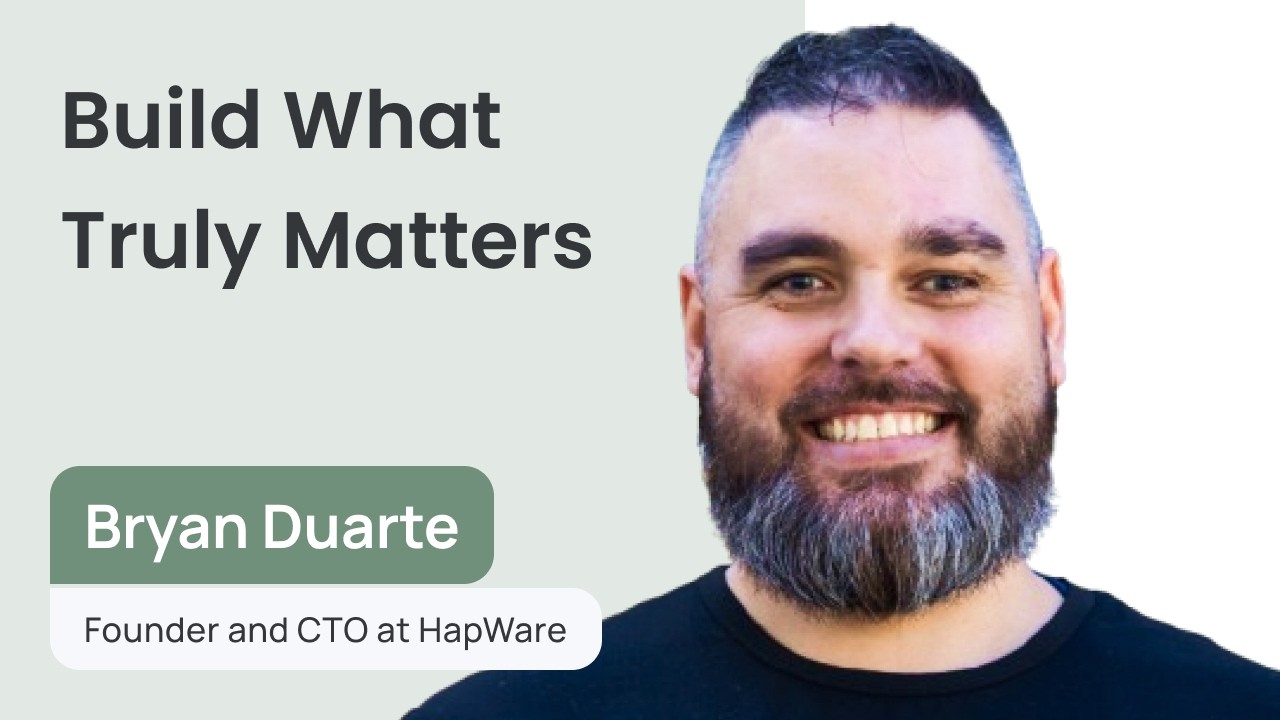
For Bryan Duarte, technology is most meaningful when it helps people experience more of the world around them. As Founder and CTO of HapWare, Bryan is developing assistive wearable technology designed for people who are blind, have low vision, or are deafblind. The company’s mission is ambitious but deeply human: to make social interactions more universally accessible.
Through its wearable wristband, ALEYE, HapWare translates facial expressions, hand gestures, and body language into real-time haptic feedback that users can understand through touch. Bryan’s connection to this work is both professional and personal, shaped by his PhD research in haptics and his own experience of becoming blind at the age of 18. What began as an engineering research project with his co-founder, exploring whether emotions could be communicated through touch, gradually revealed a much bigger opportunity.
Testing the technology with real users showed Bryan that HapWare was not simply an interesting technical experiment—it could genuinely change how people connect with others and understand their surroundings. In our conversation, Bryan shares the science behind haptics, the personal journey that shaped his mission, and how a project built around curiosity grew into technology with the potential to make everyday human connection more inclusive.
Turning Touch Into Connection
What started as an engineering experiment quickly became something much more meaningful for Bryan. His background in haptics, computer vision, and human-computer interaction gave him a simple but powerful question to explore: could information normally picked up through sight be translated into touch? Together with his co-founder, he began testing whether emotions like happiness, anger, sadness, or surprise could be communicated through haptic feedback. The early goal was not to build a company or chase a market opportunity—it was simply to see whether the technology could work in a way people could actually understand.
The results changed the direction of the project. As Bryan and his team spent more time testing, refining, and listening to people who were blind, had low vision, or were deafblind, they realized there was a genuine need for what they were building. HapWare evolved around the idea that social interaction should not depend entirely on sight or hearing. Its wearable technology can translate things like facial expressions, gestures, and body language into signals felt through touch, giving users another way to understand what is happening around them. For Bryan, haptics is especially fascinating because touch is not just another notification channel—it can become an entirely different way of receiving information.
That mission also became deeply personal. Bryan was born sighted but lost his vision at 18 after a serious motorcycle accident, an experience that completely reshaped how he interacted with the world. Years later, while developing and testing HapWare's technology, he began using it himself and discovered just how much of a difference that extra layer of information could make in everyday situations. Even something as ordinary as shopping with his wife felt different when he had a better sense of what was happening around him. What began as a technical challenge had turned into technology Bryan could personally rely on—and a reminder that the most valuable products often emerge when engineering meets a real human need.
It became personal when I saw the impact

Bryan DuarteFounder and CTO at HapWare
Confidence Turns Fear Into Freedom
For Bryan, losing his sight changed far more than the way he moved through the world. In the early years, the anniversary of his accident was something he dreaded, a yearly reminder of everything that had changed. Over time, though, that date began to mean something different. Instead of looking back at what he had lost, Bryan started looking at what he had built, what he was capable of, and how his experience could help other people. The biggest transformation, he says, was not learning Braille or mastering assistive technology—it was learning to trust himself again.
That distinction matters because practical skills can be taught, while confidence has to be built through experience. A blind person can learn how to use a cane, navigate with a phone, cook, work, travel, and raise a family, but fear can still make those skills feel impossible to use. Bryan describes something as simple as standing alone in a parking lot with no clear sense of direction: the problem is not always knowing what to do, but trusting that you will figure it out. Each successful attempt becomes proof that uncertainty does not have to stop you. That mindset eventually gave Bryan the freedom to approach difficult situations with a simple belief: he has handled challenges before, and he can handle the next one too.
That same thinking also shapes how he sees HapWare. Bryan believes tools like ALEYE can be especially powerful for children, people who are gradually losing their vision, and those adjusting to blindness because they can learn to understand visual social cues through touch from the beginning. A smile can feel like a curved pattern across the wrist, a wave can move back and forth, and other gestures can be represented through distinct tactile signals that quickly become familiar. The goal is not simply to tell someone whether another person is happy or angry, but to reveal the smaller details—raised eyebrows, crossed arms, expressive hand movements—that make conversations richer and more intimate. With repetition, Bryan says, those patterns can become almost as natural as recognizing a familiar ringtone.
Don’t let fear impact your confidence
Bryan DuarteFounder and CTO at HapWare
Designing Technology People Actually Want
For Bryan, accessibility does not mean forcing everyone to experience technology in exactly the same way. Since he is also a user of HapWare, customization was built into the product from the start. Users can adjust the strength of the haptic feedback, making it stronger or softer depending on what feels comfortable, and they can also choose which social cues they want to receive. Someone at home, for example, may care about smiles, frowns, crossed arms, shrugs, or an invitation for a hug, while other gestures simply are not relevant in that setting. Instead of flooding the user with information, HapWare lets people decide what is useful to them.
That same thinking explains why Bryan chose touch rather than relying entirely on audio. During a conversation, your ears are already busy listening to another person—or helping you keep track of your own thoughts while you speak. Add a voice constantly announcing “smile,” “handshake,” or “yawn” in the background, and a natural conversation can quickly become exhausting. HapWare can still provide spoken feedback, especially while someone is learning the system, but Bryan sees audio as more of a bridge. Once the haptic patterns become familiar, the idea is that users can turn the speech off and understand the signals through touch without interrupting the conversation itself.
Even the decision to place the technology on the wrist came from a long process of testing rather than a lucky guess. Early prototypes covered much of the forearm with motors, wires, and larger batteries, and technically, they worked—but people simply did not want to wear them. Bryan and his team kept shrinking the design, testing different motor layouts and refining the hardware until it became closer to the size and feel of a smartwatch. That process taught them an important lesson: assistive technology cannot succeed simply because it functions well. It also has to feel comfortable, look natural, and fit into someone’s life without making them feel like they are wearing a science experiment.
We give people the ability to customize things
Bryan DuarteFounder and CTO at HapWare
Stay the Course, Build Bigger
For Bryan, the future of HapWare is being shaped as much by its users as by the team building it. Feedback keeps opening doors they had not originally considered—from recognizing animals for blind users to exploring how the technology could support neurodiverse people who may see a facial expression but struggle to connect it with the emotion or intent behind it. HapWare is also opening its ALEYE wristband to developers through an SDK, allowing others to build their own applications, create haptic patterns, and use touch as an output for entirely new technologies. Bryan sees that as part of a much bigger goal: haptics will only become truly powerful when it moves beyond one product and becomes a familiar way for people to receive information.
But expanding the possibilities does not mean rushing to tell users more than the technology actually knows. Bryan is careful about the difference between recognizing a facial expression and interpreting an emotion. A smile does not always mean happiness, just as a frown could mean anger, confusion, concentration—or simply that someone stepped on a Lego. That is why HapWare places so much emphasis on accuracy and reducing false positives. Interestingly, the tactile patterns the team developed also turned out to closely match techniques already used by pro-tactile interpreters for deafblind people, suggesting that HapWare is not simply inventing arbitrary vibrations—it is building on a language of touch that people already understand.
That same sense of purpose carries into Bryan’s advice for anyone building a company. Startup life, as he describes it, can swing from winning funding or an award to wondering why the technology suddenly refuses to work—sometimes within the space of a day. His answer is not to chase every opportunity or abandon the mission when things become difficult, but to remain flexible without losing sight of why the company exists. HapWare’s founding principle is to deliver positive value to the people who need it most, and Bryan believes that principle has to survive the highs, the lows, the fundraising, and the pressure to grow. The roller coaster is unavoidable; staying committed to something that genuinely matters is what keeps you on it.
If it matters to you and others, stay the course