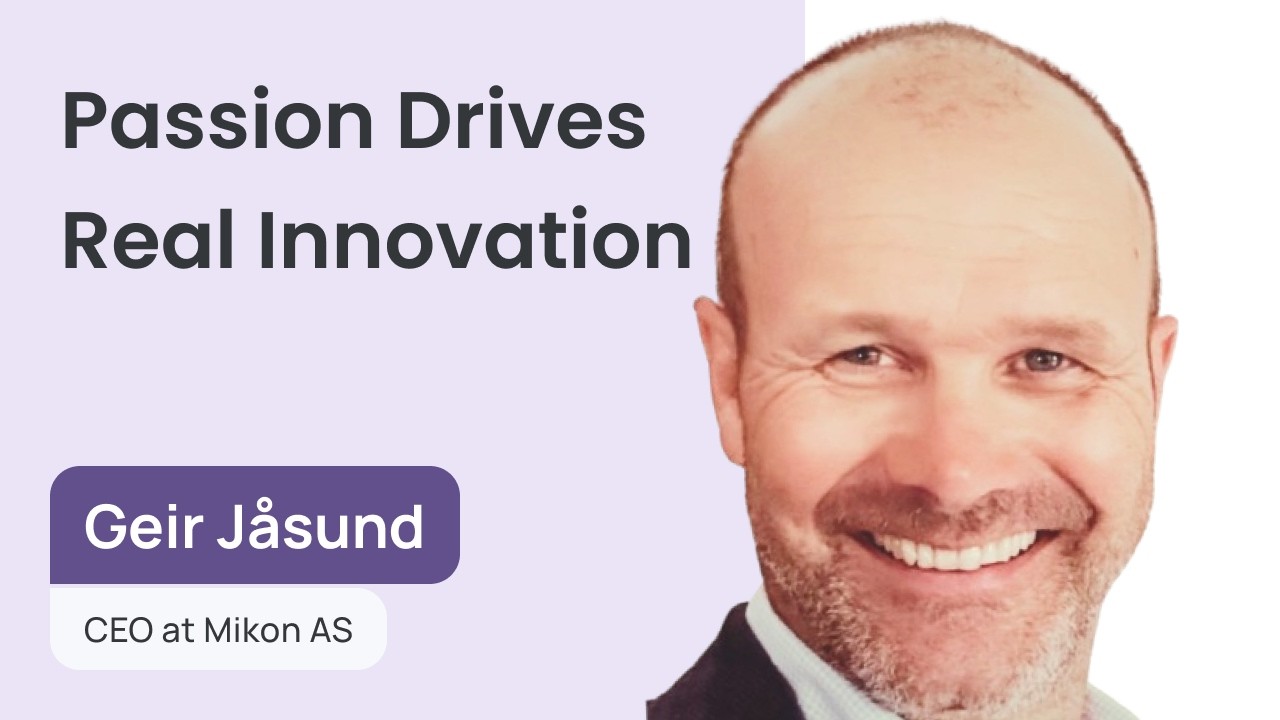
From early experiments with artificial intelligence to leading innovative software solutions for industry, Geir Jåsund’s journey reflects decades of curiosity, persistence, and entrepreneurial spirit. As the CEO of Mikon AS, he leads a company focused on industrial reporting systems and AI-driven technologies for manufacturing businesses.
With a background in software engineering and extensive international experience, Geir has worked on software projects and installations across Europe, the UK, and Brazil. His fascination with AI dates back to the early 1990s, when he was already exploring expert systems designed to support complex industrial operations. In this conversation, he shares how those early ideas have evolved into today’s powerful AI applications for manufacturing and process industries.
Geir also discusses the opportunities AI creates for improving efficiency, reducing waste, and optimizing energy consumption in modern production environments. Beyond Mikon AS, his entrepreneurial mindset has led him to launch several ventures, from consulting services to an e-commerce business. In this episode of Bright Founders Talk, we explore Geir’s journey, his perspective on industrial AI, and the lessons he has learned from decades in the software industry.
From Strawberry Fields to Industrial AI: Geir Jåsund’s Entrepreneurial Journey
Long before leading a software company that builds AI solutions for manufacturing, Geir Jåsund was already used to working hard. Growing up in Norway, he started earning money early — biking for more than an hour to pick strawberries at the age of eleven. That early drive never really left him. Over the years he worked on farms, took on different jobs, and slowly discovered something important about himself: he loved creating things and building value. Running companies, as it turns out, was a natural next step.
Today, Geir is the CEO of Mikon AS, a software company developing industrial reporting systems and AI solutions for manufacturing businesses. But that’s only part of the story. Alongside Mikon, he runs a web shop importing products to Norway and a consultancy that helps foreign companies enter the Norwegian market — what he jokingly calls “reverse exports.” Free time isn’t really part of the plan. Even when he does step away from work, he finds new creative outlets, like recently taking up drawing.
I really enjoy creating things and creating value

Geir JåsundCEO at Mikon AS
Geir’s fascination with artificial intelligence also goes much further back than most people expect. In the early 1990s, he was already working with expert systems designed to support offshore rescue operations in Norway — complex software meant to organize responses to disasters at sea. The technology back then simply wasn’t ready: computers were too slow and data was limited. But the idea stayed with him. Decades later, with powerful hardware and modern AI models, Geir is finally seeing those early concepts come to life — especially in industries that are only now beginning to unlock the real potential of AI.
Looking Through the Windscreen: How AI Is Changing Industrial Operations
When Geir first worked with artificial intelligence back in the early 1990s, he wasn’t exactly convinced it would change the world. The ideas were exciting, but the technology simply wasn’t ready. Computers were slow, systems had limited capacity, and even though concepts like neural networks were already being taught at universities, they couldn’t really perform at scale. Looking back, Geir admits that at the time he didn’t think much would come from it.
Honestly, I thought this was crap — the computers were just too slow
Geir JåsundCEO at Mikon AS
Fast forward to today, and the same concepts that once seemed impractical are now at the core of what his company, Mikon AS, does every day. Traditionally, the company helped manufacturing businesses track production data — things like efficiency, energy use, waste, and emissions. But Geir says that kind of reporting only tells you what has already happened. Now the focus has shifted toward something far more valuable: predicting what will happen next. With AI-driven forecasting and operator support, manufacturers can optimize production before problems even occur.
Interestingly, when Geir works with industrial clients, he often hears the same story: every company believes their situation is completely unique. In reality, the challenges are surprisingly similar. Factories struggle with inefficiencies, unused capacity, and scattered data. Many still rely on dozens — sometimes hundreds — of Excel spreadsheets to fill the gaps between expensive enterprise systems. Geir’s approach usually starts with a simple workshop, sitting down with teams to understand how they actually operate. Because once you look closely, the real opportunities for improvement are almost always hiding in plain sight.
Conservative Industry, Revolutionary Technology: Why AI Is the Next Big Shift
Manufacturing companies don’t usually rush into change. As Geir explains, most of them sit somewhere between curiosity and caution. After all, factories can’t simply pause production to experiment with new tools — machines must keep running, and upgrades can be expensive. Some companies aggressively chase new opportunities, while others stick with processes that have worked for decades. But more often than not, the real barrier isn’t a lack of interest — it’s the complexity of making change happen inside large organizations.
Most manufacturing companies are fairly conservative — they have to keep the machines running
Geir JåsundCEO at Mikon AS
Interestingly, company size doesn’t always determine how quickly innovation happens. Geir points out that in large global enterprises, decision-making can actually be slower. A single factory might see clear opportunities for improvement, but approval has to travel through layers of corporate hierarchy before anything moves forward. By the time decisions finally reach the plant floor, months — sometimes years — may have passed. In many cases, the willingness to innovate is there; it’s the structure that slows things down.
Despite these challenges, Geir believes the next big transformation in manufacturing is already underway. Robotics will continue to expand as it becomes cheaper and more capable, but AI is where the real disruption lies. Instead of overwhelming operators with endless alarms and data dashboards, AI can help filter what actually matters. In complex control rooms where hundreds of alerts compete for attention, intelligent systems can highlight the signals that truly require action. And with modern language models translating complex predictions into clear explanations, AI may soon become the quiet assistant helping humans make faster — and better — decisions on the factory floor.
AI, Robots, and the Human Factor: Geir’s View of the Future
For Geir, the future of AI is both thrilling and a little unsettling — and he’s honest about both sides. On one hand, the technology is advancing at an astonishing speed. On the other, it raises serious questions about responsibility and control. While many people fear that AI is unreliable because it sometimes “hallucinates,” Geir sees the situation differently. Humans make mistakes too, he reminds us — sometimes with just as much confidence. The key isn’t blind trust in machines, but learning how to evaluate and work alongside them.
You still have to judge the AI — just like you judge people
Geir JåsundCEO at Mikon AS
What excites Geir most is how quickly the technology is improving. In his daily work he uses tools like ChatGPT and Claude constantly, and the difference from just a year ago is already dramatic. At Mikon, AI is even integrated into internal support systems, helping engineers solve technical issues faster. For Geir, the pace of progress still feels exponential — each new generation of tools arriving smarter, faster, and more capable than the last. It’s a reminder that we’re not at the peak of the AI revolution yet; we’re still climbing.
Looking ahead, Geir expects manufacturing to evolve steadily rather than overnight. Factories will likely become more efficient, cleaner, and safer, with AI helping reduce waste, energy use, and emissions. Robotics will continue to take over dangerous or physically demanding tasks, while human workers focus more on decision-making and oversight. But one thing probably won’t change: the need for people who genuinely enjoy building things. When asked for advice to future founders and entrepreneurs, Geir keeps it simple — if you love what you do, the rest tends to fall into place.