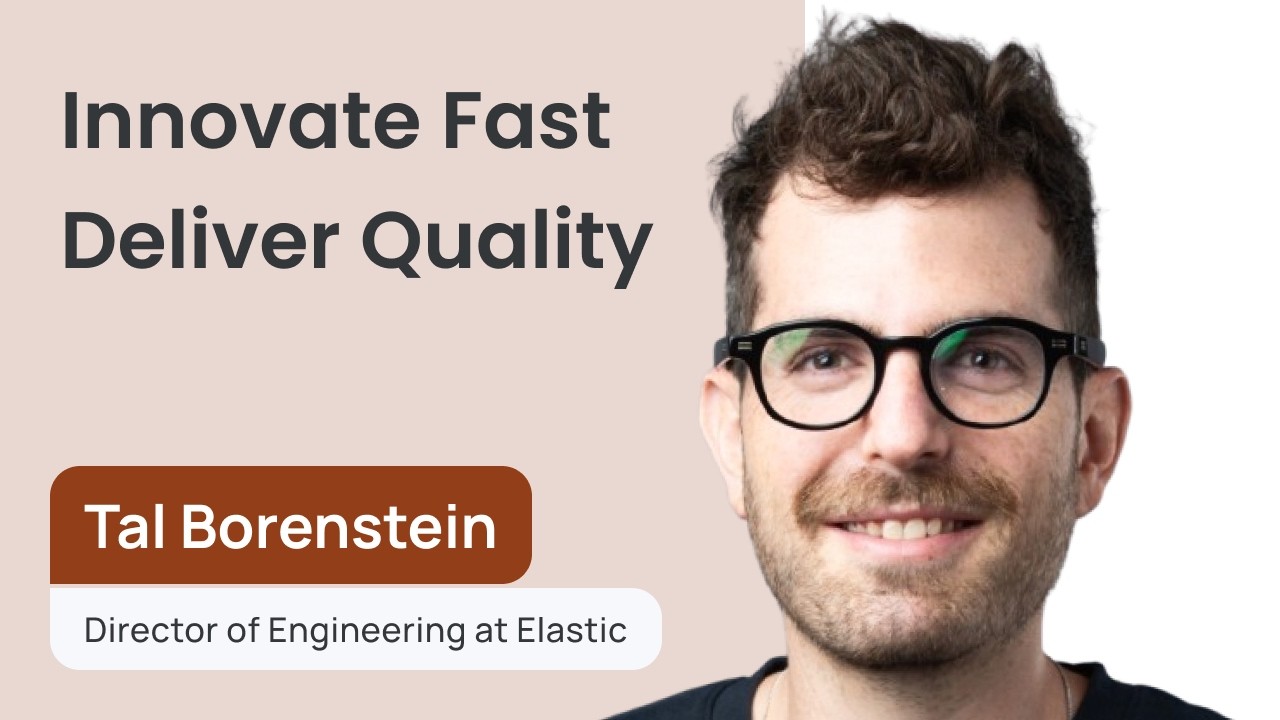
In today’s rapidly evolving software landscape, the stories behind successful engineering leaders offer valuable lessons for innovators and entrepreneurs alike. In this interview, we speak with Tal Borenstein, Director of Engineering at Elastic, whose journey spans over a decade in cybersecurity and startup innovation.
From his early days as a software engineer to becoming a founding engineer and entrepreneur, Tal’s path reflects both technical depth and entrepreneurial ambition. His experience includes co-founding Keep, an open-source AIOps platform later acquired by Elastic, where he now leads workflow automation initiatives. Throughout the conversation, Tal shares insights into building scalable solutions, navigating startup ecosystems, and transitioning from engineering to leadership.
He also sheds light on what makes Israel a unique hub for technological innovation and startup growth. With a blend of practical experience and forward-thinking perspective, Tal offers a compelling look into the realities of building impactful technology. This article captures the key moments and insights from our discussion, providing inspiration for anyone shaping the future of software.
From Startup Dreams to Startup Nation: Tal’s Journey Through Code, Courage, and Chutzpah
Tal’s story doesn’t start with a grand vision of building a company—it starts with code. Back in 2012, he stepped into the tech world as a software engineer, a role that shaped his thinking and grounded his career. Over the years, he found himself deep in the cybersecurity space, moving through startups, learning fast, and building even faster. Eventually, that path led him to co-found Keep, an open-source AIOps platform that caught enough attention to be acquired by Elastic. Today, he’s still building—only now at scale—working on workflow automation solutions inside Kibana.
But behind the career milestones, there’s a story that feels almost cinematic. Tal met his co-founder years ago during their time in the Israeli Defense Forces, and something just clicked. They stayed connected, even as their paths diverged, always carrying the same idea in the back of their minds: one day, they’d build something together. That “one day” finally came during COVID, when the timing felt right and the startup energy around them was impossible to ignore. As Tal puts it, “We always had this dream to start our own thing.” And eventually, they did.
We always had this dream to start our own thing

Tal BorensteinDirector of Engineering at Elastic
Of course, building a startup in Israel comes with its own unique flavor. Tal points to a mix of factors: elite technical training from the IDF, a tight-knit ecosystem, and something less tangible but just as powerful—chutzpah. It’s that direct, fearless mindset that makes people reach out, ask questions, and push forward without overthinking. For engineers suddenly stepping into sales or business roles, that attitude becomes a real advantage. It doesn’t make the journey easy—but it definitely makes it possible.
Beyond Search: How Elastic Evolved into a Data Powerhouse in the Age of AI
Elastic may have started as a search engine, but today it’s playing a much bigger game. Built on top of the powerful open-source foundation of Elasticsearch and Kibana, the company now delivers three core solutions: security, observability, and search. From acting as a SIEM engine to competing with platforms like Datadog and Grafana, Elastic has grown into a full-scale data platform. And at the heart of it all is the same thing that made it successful in the first place—a fast, flexible engine that developers can build almost anything on top of.
What really sets Elastic apart, though, isn’t just the tech—it’s the time and depth behind it. Years of working with open source, contributions to Lucene, and real-world usage at massive scale (think Fortune 500 companies) have helped shape it into one of the strongest players in the space. Tal is quick to point out that this kind of maturity can’t be rushed. It’s the result of constant iteration, a strong engineering culture, and a commitment to pushing the boundaries of what search technology can do. Or as he puts it, “Elastic is still one of the strongest search engines out there.”
Elastic is still one of the strongest search engines out there
Tal BorensteinDirector of Engineering at Elastic
Now, with AI reshaping how we interact with data, Elastic is evolving again. But this time, it’s not just about better dashboards or smoother user interfaces. The shift is deeper—from user experience to what Tal calls “agent experience.” Instead of designing products only for humans, teams are starting to think about how AI agents will interact with their systems too. That means building tools, APIs, and workflows that machines can understand and act on just as easily as people. It’s a subtle shift, but a powerful one—and it’s already changing how modern software gets built.
From Data Overload to Smart Insights: Designing the “Agent Experience”
The way we interact with data is changing—and fast. It’s no longer just about dashboards and buttons; it’s about conversations. Tal describes this shift as a move toward “user experience 2.0,” where humans don’t just click through interfaces but actually talk to their data. Think chat-based interactions, where you ask questions, refine results, and instantly see visual outputs tailored to your intent. Behind the scenes, it’s not magic—it’s a careful blend of context, structure, and smart design that makes the experience feel seamless.
But with great data comes a familiar headache: too much of it. The challenge isn’t just retrieving information anymore—it’s making sure what you get actually matters. That’s where relevance becomes everything. Elastic tackles this with layers of smart filtering and ranking, ensuring users (and agents) see what they need, not a wall of noise. And then comes the visual side—what Tal calls generative UI—where the system doesn’t just return data, but shapes how it’s presented based on what you’re trying to achieve. As Tal puts it, “It’s about showing data in a way that works for you.”
It’s about showing data in a way that works for you
Tal BorensteinDirector of Engineering at Elastic
Still, the biggest challenge hasn’t gone away—it’s just grown bigger. AI has amplified the data problem to a whole new level, with exploding volumes and limited context windows. Feed an AI too much—or the wrong—information, and things start to break: irrelevant answers, hallucinations, missed intent. It’s a constant balancing act. Tal compares it to a cat-and-mouse game, where improvements in AI are matched by the growing complexity of data. Elastic’s approach? Don’t limit the data—store it all, and handle relevance at retrieval time. It’s a bold way to keep control in a world where data just won’t stop growing.
Move Fast, Stay Reliable: Tal on Scaling Innovation Without Breaking Things
In the early days of a startup, speed is everything. You build, you ship, you fix—it’s a constant loop of experimentation. Tal remembers that phase well from his time at Keep, where innovation often took the front seat and reliability followed close behind. When you don’t yet have massive customers relying on your product, you can afford to move fast, take risks, and figure things out along the way. It’s messy, but it’s also where the magic happens.
Things change when you step into a company like Elastic. Suddenly, reliability isn’t just important—it’s non-negotiable. But instead of losing that startup energy, Tal and his team brought it with them. The challenge became finding the sweet spot: moving quickly while building systems that won’t break under pressure. Thanks to better tools, stronger infrastructure, and advances in AI, that balance is more achievable today than ever. As Tal puts it, “You can run fast and still have high quality.”
You can run fast and still have high quality
Tal BorensteinDirector of Engineering at Elastic
And when it comes to building something from scratch, Tal keeps his advice simple—and sharp. Don’t chase size too early. Focus on hiring the right people, not more people. Keep your team small, efficient, and aligned around a clear mission. In a world where technology lets small teams do big things, being lean is no longer a limitation—it’s an advantage. For founders just starting out, that mindset might be the difference between building something good… and building something that actually lasts.