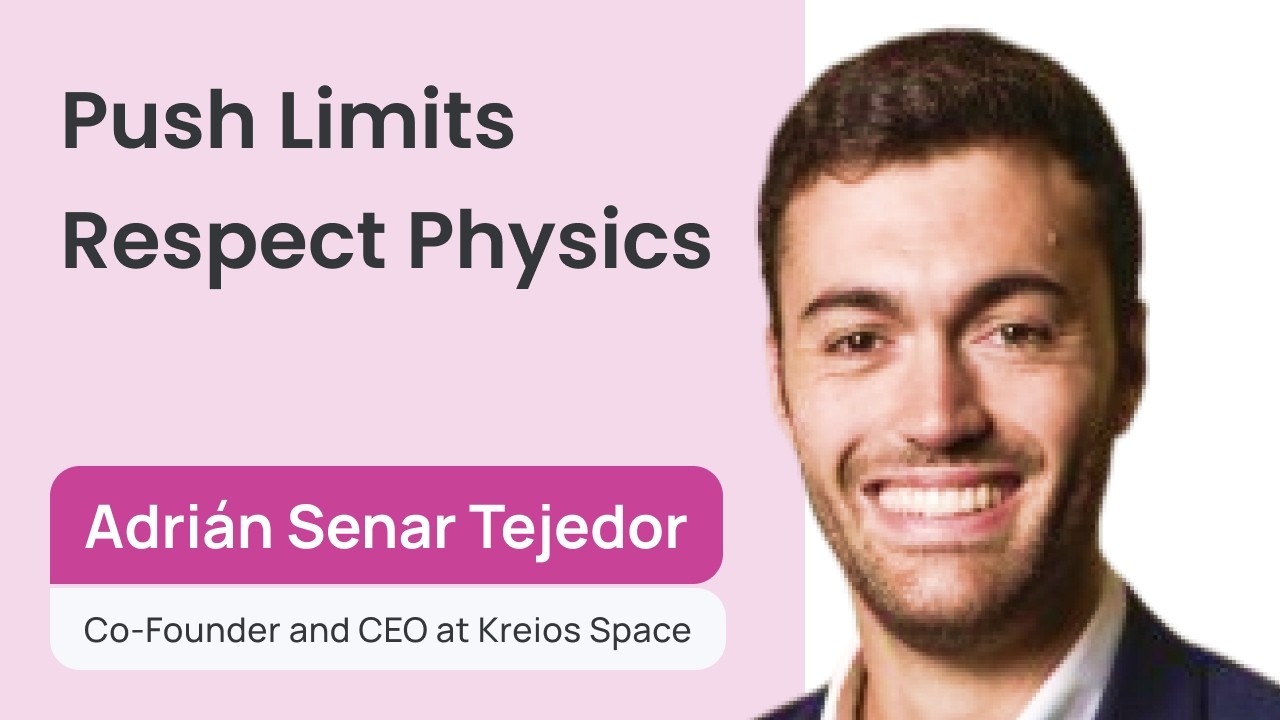
For Adrián Senar Tejedor, space has never been just a distant fascination — it has been the direction of his career from the very beginning. As Co-Founder and CEO of Kreios Space, Adrián is working on a technology that could open an entirely new region of space for satellite operations. His journey started with a childhood dream of becoming an astronaut, but his curiosity eventually led him toward engineering and the technical challenges behind space exploration.
That passion later evolved into entrepreneurship, where he found the freedom to build something of his own alongside people who shared the same ambition. Kreios Space was born from that combination of deep technical knowledge, startup experience, and a desire to solve a problem the industry had struggled with for years. The company is developing propulsion technology designed to keep satellites operating at very low Earth orbits, around 200 kilometers above the planet. By using particles from the upper atmosphere as a source of propellant, Kreios Space aims to overcome the atmospheric drag that normally makes operating at these altitudes extremely difficult.
In this conversation, Adrián shares how the idea came together, why very low Earth orbit could transform satellite communications and observation, and what it takes to engineer technology for a part of space that has barely been used before.
Breathing the Atmosphere: A New Way to Keep Satellites in Orbit
For Adrián, building Kreios Space was never about escaping a boss or simply calling himself a founder. What mattered was having the freedom to work on something he genuinely cared about and to shape the future of a project that felt like his own. The idea came together naturally after years of studying space engineering and gaining experience in the startup world. Then one conversation with his future CTO turned that background into something much bigger: why not build a company around a problem they already understood and genuinely loved solving?
That problem sits much closer to Earth than most people might expect. Satellites usually operate hundreds of kilometers above the planet, but moving them lower can improve both observation and communication. The catch is atmospheric drag. At around 200 kilometers, the remaining particles of the atmosphere slow satellites down so aggressively that a spacecraft that might survive for years higher up could remain in orbit for only a short time. Yet those very low orbits also come with an interesting advantage: debris does not remain there for long, which could make the environment far less crowded than the increasingly congested regions used by many satellites today.
Kreios Space decided to approach the challenge from a completely different angle. Traditional satellites carry a limited supply of propellant, and once that runs out, the mission eventually comes to an end. Adrián and his team asked a far more ambitious question: what if the satellite did not need to carry all of its fuel in the first place? Their answer was to use the upper atmosphere itself, collecting its particles and turning them into propellant for the spacecraft. It sounds beautifully simple when Adrián explains it, but making it work has required years of engineering and development — the kind of long-term effort needed when you are trying to open an entirely new operating region in space.
Let’s use the atmosphere as our propellant tank

Adrián Senar TejedorCo-Founder and CEO at Kreios Space
Closer to Earth, Bigger Possibilities
Getting satellites closer to Earth changes more than just the quality of the images they can capture. Adrián explains that very low orbit can improve almost everything satellites already do while also making many services more affordable. Better resolution means sharper observation with the same hardware, which can reduce costs for the end user and open the door to applications that are currently too expensive to make sense commercially. That could have a major impact on areas such as environmental monitoring, security, defense, and any field that depends on seeing more detail from space.
Telecommunications could benefit just as much. With satellites operating closer to Earth, signals travel shorter distances and the hardware needed on the ground can become much smaller. That makes direct satellite connectivity to smartphones far more realistic, which Adrián sees as one of the most exciting possibilities. The difference in scale can be dramatic: instead of relying on extremely large satellites to provide that kind of connection, very low orbit could make similar performance possible with a much smaller platform. And if something goes wrong, there is another advantage — satellites naturally deorbit much faster, reducing the risk of leaving long-term debris behind.
For Adrián, though, building this kind of future requires a careful balance between ambition and reality. He likes the big picture and the long-term potential of the technology, but budgets, timelines, and physics still set very real limits. His solution is to focus on the most valuable short-term applications first, get something practical into the market, and keep the bigger vision alive for later. He also believes startups need ambitious goals that genuinely stretch the team, because playing it too safe can be just as dangerous as aiming too high.
If you never miss a milestone, you may not be pushing hard enough
Adrián Senar TejedorCo-Founder and CEO at Kreios Space
From Earth Tests to Orbit
Adrián is quick to admit that running a space company sounds glamorous from the outside, but the reality is a lot more demanding. He genuinely loves the work, and that is what makes the long hours, constant pressure, and inevitable headaches worth it. For him, the excitement comes from being deeply connected to the mission, the technology, and the people building it alongside him. Without that kind of passion, he says, the job would be incredibly difficult to sustain.
That passion is now being tested in the most literal way possible. Kreios Space is preparing for what Adrián describes as a first-of-its-kind mission, designed to prove that the thruster his team has spent years developing can actually perform in orbit. The technology has already gone through extensive testing on Earth, but there comes a point when simulations and vacuum chambers are no longer enough. The real test is space itself, and this mission will not only validate the core technology but also generate valuable data for the wider scientific community about how very low Earth orbit can be used in practice.
Getting to that stage required more than strong engineering. Adrián says the company needed both a viable technology and the capital to take it into orbit, which meant convincing investors that the opportunity was ambitious but still realistic. Kreios Space has tried to strike that balance with a clear go-to-market strategy, customer demand, strong partnerships, and a team capable of delivering the technology. And while the mission itself is a huge milestone, Adrián is especially proud of the people behind it — because in his view, great technology only becomes a real company when there is a strong team capable of turning it into something bigger.
The thing I’m most proud of is the team we built
Adrián Senar TejedorCo-Founder and CEO at Kreios Space
Ambition Has Limits — Physics Does Too
For Adrián, Europe’s future in space is not about trying to build absolutely everything on its own. What matters more is knowing which technologies are truly strategic and making sure those capabilities stay in-house. He sees very low Earth orbit as one of those areas, especially as the United States, China, and India continue investing heavily in it. Europe does not need complete isolation, but it does need enough technological strength to remain competitive, independent where it matters, and able to choose its partners from a position of confidence.
That same balance between ambition and realism shapes Adrián’s vision for Kreios Space. He expects the company to grow far beyond a single technology and eventually become a platform for continuous innovation in space. But he is also clear about where the boundaries are: engineering problems can usually be solved with enough time, talent, and money, while the laws of physics are a different story. For the next decade, the company’s focus remains around Earth because the opportunity there is already enormous. Beyond that, Adrián is much more open-minded — including the possibility of technologies that could eventually support interplanetary activity.
His advice to aspiring founders follows the same philosophy. Starting a company should not be treated like a motivational slogan or an automatic path to freedom. It can consume years, create financial uncertainty, and demand a level of commitment that is difficult to understand before experiencing it firsthand. Adrián believes the decision only makes sense when the founder is genuinely passionate enough to dedicate a decade of life to the problem. Ambition matters, but so does knowing exactly what you are signing up for.
You cannot negotiate with physics